uae-taxconsultants.com

UAE Tax Residency Certificate (TRC): Eligibility, Benefits & Step-by-Step Process (2026 Guide)
UAE Tax Residency Certificate (TRC): Eligibility, Benefits & Step-by-Step Process (2026 Guide)
Gupta Group International
1/20/20266 min read


UAE Tax Residency Certificate (TRC): Eligibility, Benefits & Step-by-Step Process (2026 Guide)
The UAE Tax Residency Certificate (TRC) has become one of the most valuable official documents for individuals and companies operating across borders. Whether you’re an expatriate investor, entrepreneur, or a corporate entity seeking global business credibility, understanding the TRC — from eligibility and benefits to how you can apply — is mission-critical.
In this guide, we’ll walk you through everything you need to know about the UAE TRC in 2026 — including eligibility criteria, key benefits, required documents, application steps, timelines, fees, common mistakes and how UAE-TaxConsultants.com can help you secure your certificate smoothly.
What is a UAE Tax Residency Certificate (TRC)?
A Tax Residency Certificate (TRC) is an official document issued by the UAE Federal Tax Authority (FTA) that certifies that an individual or legal entity is a tax resident of the UAE for a specified period. It’s recognized by foreign tax authorities as evidence that you are resident in the UAE for tax purposes and are therefore eligible for tax treaty benefits under the UAE’s network of international agreements.
In simple terms:
For individuals, a TRC confirms that you lived in the UAE long enough in a given period to be considered a tax resident.
For companies, it confirms that your entity is a resident of the UAE and compliant with UAE tax rules.
With the UAE’s network of Double Taxation Avoidance Agreements (DTAAs) spanning more than 130 countries, the TRC is a gateway to significant tax benefits on global income.
Why Does the TRC Matter? — Key Benefits Explained
Obtaining a UAE Tax Residency Certificate offers multiple tangible financial and strategic advantages for both individuals and companies:
1) Avoid Double Taxation:
One of the most important benefits of a TRC is that it enables taxpayers to avoid being taxed twice on the same income—once in the UAE and once in another country. This is possible because the TRC allows you to claim benefits under the UAE’s DTAAs.
2) Reduced Withholding Tax:
With a TRC, residents can often enjoy lower or zero withholding tax rates on dividend, interest, and royalty payments in countries with which the UAE has treaties.
For example, if your home country charges a 15% withholding tax, a TRC may reduce it to 5% or even 0%, depending on the treaty terms.
3) International Tax Compliance:
A TRC is widely accepted by foreign tax authorities as formal proof of residency, helping you navigate international compliance — especially during audits or treaty-based claims.
4) Stronger Business Credibility:
Banks, investors, strategic partners, and overseas counterparties often require a TRC as part of due diligence — improving your business credibility and openness to global opportunities.
5) Support for Global Business Structures:
For multinational companies, a TRC helps in structuring cross-border holding companies, financing arrangements, and intellectual property flows, with minimized tax leakage and disputes.
6) Simplifies Expatriate Financial Planning:
For individuals — especially high-net-worth expats — a TRC enables smoother wealth planning and investment structuring across borders by reducing friction with foreign tax authorities.
Who is Eligible for a UAE TRC?
Eligibility for a TRC depends on whether you are applying as an individual (natural person) or a company (legal person). The rules and requirements are clearly outlined by the UAE Ministry of Finance and the FTA.
1) Eligibility for Individuals:
To qualify as a tax resident and apply for a TRC:
Mandatory Conditions
You must be a resident of the UAE with a valid residence visa.
You must have physically resided in the UAE for at least 183 days in the applicable period.
You must supply supporting documentation like tenancy records or utility bills showing evidence of your residence.
Note: Some applicants might apply with fewer days (e.g., 90+ days) if they have compelling proof of strong connections to the UAE (job, residency, family, social, financial ties), but 183 days is the standard benchmark for most individuals.
2) Eligibility for Companies
A legal person (company) must meet these criteria:
Have been established in the UAE for at least one year.
Prepare and submit audited financial accounts covering the period for which the TRC is requested.
Have a valid UAE trade license and active business presence.
Provide supporting documents such as lease contracts, bank statements, and authorized signatory details.
Important: Offshore companies (like JAFZA Offshore or RAK ICC entities) are typically not eligible to apply for a TRC because they aren’t listed under the UAE’s DTAA partner regimes.
Required Documents Checklist
Document requirements differ between individuals and companies. Below is a breakdown of what you’ll need:
1) For Individuals:
Valid Passport Copy
Valid UAE Residence Visa
Emirates ID
Entry and Exit report from UAE immigration authorities
Official tenancy or lease agreement (e.g., Ejari) or title deed
Local bank statements (6+ months)
Proof of income (salary certificate, employment contract)
2) For Companies
Trade license and registration certificate
Audited financial statements covering the certification period
Valid UAE bank statements
Lease agreement for office / premises
Memorandum of Association (MOA) and shareholder IDs
Proof of authorization (POA or authorized signatory ID)
Fee Structure & Validity
2) Validity
A TRC is valid for one year and reflects tax residency only for the period specified in your application. Typically, this period must be in the past or current — you cannot apply for a future period only.
Most certificates are issued for either a calendar year (Jan-Dec) or a custom period that matches your home country reporting cycles.
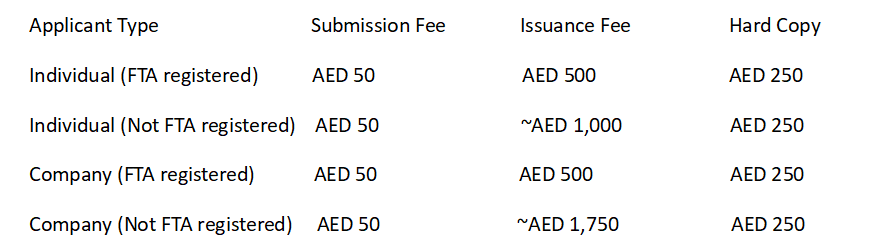
1) Fees
The application and issuance fees for TRCs vary based on applicant type:
Step-by-Step TRC Application Process (2026)
Here’s a practical, easy-to-follow breakdown of how to apply for your UAE Tax Residency Certificate through the official channels:
Step 1 — Prepare Your Documents
Collect all required documents based on your applicant type (individual or company). Ensure your documents are complete, accurate, current and digitally ready (PDF preferred).
Step 2 — Create/Log In to EmaraTax
Go to the official EmaraTax portal via the Ministry of Finance (tax.gov.ae).
Use your UAE Pass or existing credentials to log in.
Step 3 — Select TRC Application
In the portal:
Go to “Other Services”
Choose “Tax Residency Certificate”
Select the applicable TRN (Tax Registration Number) or choose “No TRN” if none.
Step 4 — Choose TRC Type
You can select either:
TRC for treaty purposes (to claim DTAA benefits), or
Domestic TRC (for local purposes).
Step 5 — Upload Documents
Upload all supporting documents. Make sure file names are correct and formats are accepted. The system may check for completeness before submission.
Step 6 — Pay Fees
First, you’ll pay a submission fee (AED 50).
Once preliminarily approved, you’ll be prompted for the issuance fee based on your category (individual vs company).
If you want a printed copy, you can request one for an additional fee.
Step 7 — Track Your Application
After submission, you can track progress through the EmaraTax dashboard. In most cases, approval takes ~3–7 business days once all documents are complete.
Step 8 — Receive Your TRC
Once approved, your TRC will be available digitally and can be downloaded. A printed version can also be delivered to your UAE address if you requested it.
Common Mistakes to Avoid
Even though the process is mostly digital, the following pitfalls can delay or jeopardize approval:
Incomplete documents or mismatched names
Misinterpreting residency requirements
Failing to provide accurate immigration entry/exit evidence
Missing audited financials for companies
Incorrect TRN selection
Applying for a future period that hasn’t happened yet
Frequently Asked Questions (FAQs)
1) Can I apply for a TRC before completing 183 days?
- Generally, you must meet the 183-day residence requirement to qualify. However, if you have compelling evidence of strong ties — like long-term residence and economic interests — there are limited cases where 90+ days may be considered.
2) How long does it take to get a TRC?
- Most applications are processed within 3–7 business days after submission of complete documents.
3) Can I use a TRC for tax filing in my home country?
- Yes — that’s the primary purpose. A TRC is accepted by foreign tax authorities to claim benefits under DTAAs.
4) What if my country doesn’t have a DTAA with UAE?
- You may still apply for a domestic TRC but treaty benefits will not apply. You’ll need to check your home country’s tax requirements.
Why Work with UAE-TaxConsultants.com?
Navigating the TRC process involves precise documentation and understanding subtle rule differences between individuals and corporate entities. At UAE-TaxConsultants.com, we help you:
Assess eligibility accurately
Prepare and organize your documents
Avoid submission errors
Track the process in real time
Maximize your chances of rapid approval
Whether you’re a resident individual or a global business, our expert tax consultants ensure a seamless, compliant, and optimized TRC application experience.
Final Thoughts
In an increasingly globalized world, official tax residency proof is more than just a certificate — it’s a strategic asset. The UAE Tax Residency Certificate (TRC) empowers individuals and companies to unlock treaty benefits, avoid double taxation, and operate with maximum tax efficiency and international credibility.
By understanding eligibility, documentation, and the application process as outlined in this guide, you can confidently navigate the UAE TRC journey and reap the benefits that come with certified tax residency.
© 2026 uae-taxconsultants.com

